


Table of Contents
- Key Points
- What Is Dental Bonding?
- What Are Dental Veneers?
- Key Differences Between Veneers and Bonding
- Which Option Is Right for You?
- Finding the Right Dentist in Greenville, SC
- Frequently Asked Questions
- References
Key Points
- Veneers offer a longer-lasting, stain-resistant solution for significant cosmetic concerns, while dental bonding provides a faster, more economical fix for minor imperfections.
- The right choice generally depends on the extent of correction needed, budget, and how much natural tooth structure a patient wants to preserve.
- A consultation with an experienced dentist in Greenville SC is the most reliable way to determine which treatment aligns with a patient’s oral health and cosmetic goals.
A confident smile can influence everything from professional first impressions to the way individuals view themselves. In fact, the psychological impacts of cosmetic dental challenges have been well documented, showing a close relationship between self-esteem and an inclination toward aesthetic dental treatments.1
For patients considering cosmetic dentistry, two of the most common options are veneers and bonding. Both procedures are designed to correct imperfections like chips, gaps, discoloration, and minor misalignment, yet they differ substantially in cost, durability, and the degree of tooth preparation involved.
Understanding the distinctions between the two treatments can help patients make a more informed decision. This article outlines the core differences between veneers and bonding, along with the clinical and practical factors to consider.
What Is Dental Bonding?
Dental bonding—sometimes called “cosmetic” or “composite bonding”—is a procedure in which a tooth-colored composite resin is applied directly to the surface of a tooth. The resin is sculpted into the desired shape, hardened with a curing light, and polished to blend with the surrounding teeth. Because the process typically requires little to no removal of existing enamel, bonding is generally regarded as one of the more conservative cosmetic treatments available.2
Bonding is often recommended for:
- Minor chips or cracks
- Small gaps between teeth
- Slight discoloration that has not responded to whitening
- Reshaping a tooth that appears shorter or uneven
- Covering a small area of exposed root following gum recession
Also, because the procedure can usually be completed in a single office visit, dental bonding is frequently chosen by patients seeking a same-day cosmetic improvement.
What Are Dental Veneers?
Veneers are thin, custom-fabricated shells, typically made of porcelain or composite resin, that are affixed to the front surface of a tooth to alter its color, shape, size, or length.3 Unlike bonding, veneer placement generally involves removing a small amount of enamel—often less than half a millimeter—to create room for the shell and support a natural-looking fit. Because enamel does not regenerate, veneers are generally considered a permanent commitment.
The veneer process is typically more involved than bonding and often requires two or more appointments:
- An initial consultation and treatment planning visit, which may include a smile mock-up
- A tooth preparation and impression visit, where enamel is minimally reshaped, and molds are taken
- A final fitting visit, where the custom veneer is permanently bonded to the tooth
Veneers are often recommended for patients with more pronounced cosmetic concerns, including widespread discoloration, uneven tooth shape, or a desire for a more uniform and symmetrical smile.
Key Differences Between Veneers and Bonding
While both treatments improve the appearance of teeth, several factors distinguish them: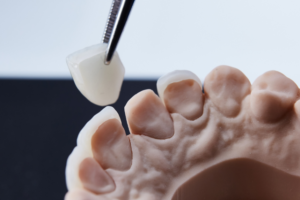
- Tooth preparation: Bonding generally preserves nearly all of the natural tooth structure, while veneers require some enamel removal.
- Number of visits: Bonding is usually completed in one appointment, while veneers typically require multiple visits spread across several weeks.
- Durability: Composite bonding generally lasts three to seven years with proper care, while porcelain veneers commonly last ten to fifteen years, with some patients reporting results lasting twenty years or longer with proper care.4
- Stain resistance: Porcelain veneers tend to resist staining more effectively than the composite resin used in bonding, which may gradually discolor over time.
- Cost: Bonding generally costs less per tooth than veneers, though total cost for either treatment depends on the number of teeth involved and the complexity of the case. Also, the longer lifespan of veneers can make their cost lower than bonding relative to how long each treatment lasts.
- Reversibility: Bonding is largely reversible since minimal enamel is removed, while veneers are generally considered a permanent commitment.
- Repairability: Minor damage to bonding can often be repaired chairside, while a damaged veneer usually needs to be remade and replaced.
Which Option Is Right for You?
The decision between veneers and bonding generally comes down to the scope of correction needed, budget, and personal preference regarding tooth preparation. Patients who want a quick, lower-cost solution for a small chip or gap may find that bonding meets their needs. Patients seeking a comprehensive, long-term smile transformation, particularly for more extensive discoloration or shape irregularities, may find that veneers offer a more durable result.
Because every smile is different, an in-person evaluation with your dentist in Greenville SC is the most reliable way to determine which treatment, or combination of treatments, will produce the best outcome.
Finding the Right Dentist in Greenville, SC
Not all dentist offices in Greenville SC offer the same level of cosmetic dentistry expertise, so it is worth asking about a provider’s experience with both bonding and veneer procedures before scheduling treatment. A qualified dentist Greenville SC patients trust will be able to explain the expected treatment timeline, cost, and maintenance requirements for each option, and will be able to make recommendations based on the individual’s oral health history.
At ProGrin Family Dental, our team works with patients throughout the Upstate to evaluate cosmetic goals alongside overall oral health, helping ensure that any treatment plan supports both appearance and long-term dental function. Reach out to us today to make an appointment at one of our 10 offices in the area.
Frequently Asked Questions
What is dental bonding?
Dental bonding is a cosmetic procedure in which a tooth-colored composite resin is applied to a tooth, shaped, and hardened with a curing light to correct minor chips, gaps, or discoloration. It typically requires little to no enamel removal and can usually be completed in a single visit.
What are dental veneers?
Dental veneers are thin, custom-made shells, typically crafted from porcelain or composite resin, that are bonded to the front surface of a tooth to improve its color, shape, size, or length. Placement generally requires removing a small amount of enamel, making veneers a longer-lasting but more permanent cosmetic option than bonding.
How long does each procedure take?
Bonding is generally completed in thirty minutes to an hour per tooth during a single visit. Veneers typically require two or more appointments spread across several weeks to allow for fabrication of the custom shell.
Is bonding or veneers better for a single chipped tooth?
For an isolated chip or minor crack, bonding is often sufficient and can typically be completed in one visit. Veneers may be worth considering if the chip is part of a broader cosmetic concern involving multiple teeth.
Are veneers or bonding covered by dental insurance?
Because both procedures are usually classified as cosmetic, they are generally not covered by dental insurance. However, some plans may offer partial coverage if the treatment also addresses a functional issue, such as a fracture, so it is worth confirming coverage details with your insurance provider in advance.
Can bonding be upgraded to veneers later?
In many cases, yes. Patients sometimes begin with bonding as a more conservative, lower-cost option and later transition to veneers if they want a longer-lasting or more extensive cosmetic result. This should be discussed with your dentist during a consultation.
References
- Zahra Ghorbani, Saharnaz Esmaeili, Soheil Shahbazi, et al., “Self-esteem and its influence on the inclination toward esthetic dental treatments: a cross-sectional study,” BMC Psychology, February 2025, https://pmc.ncbi.nlm.nih.gov/articles/PMC11840998/.
- “Dental Bonding,” Cleveland Clinic, January 2026, https://my.clevelandclinic.org/health/treatments/10922-dental-bonding.
- Ana Gotter and Jennifer Larson, “What to Know Before You Get Dental Veneers,” Healthline.com, February 2023, https://www.healthline.com/health/dental-veneers.
- Ali Alenezi, Mohammad Alsweed, Saleh Alsidrani, and Bruno R Chrcanovic, “Long-Term Survival of Porcelain Laminate Veneers: A Systematic Review.” Journal of Clinical Medicine, March 2021. https://pmc.ncbi.nlm.nih.gov/articles/PMC7961608/.

Dr. Trey Buck brings strong expertise and passion for dentistry to our practice. Born and raised in the Lowcountry area of South Carolina, Dr. Buck’s journey in the field of dentistry began with a Bachelor of Science in Public Health from the University of South Carolina, where he graduated Summa Cum Laude in 2019. He completed his dental training at the Medical University of South Carolina in Charleston, earning his degree in May of 2023. Throughout his time at the College of Dental Medicine, he consistently demonstrated exceptional academic and clinical skills, receiving awards such as the Dr. Joseph Cleveland Award, Hinman Dental Scholar Award, and the American Academy of Esthetic Dentistry Student Award of Merit. Dr. Buck was inducted into the prestigious national dental honor society, Omicron Kappa Upsilon, and received The Huynh/Huynh-Le Top Honor Graduate Award for achieving the highest grade point average (GPA).
In 2024, Dr. Buck brought his expertise to Greenville, SC, joining our team at the Woodruff office. As a dedicated member of the Greenville County Dental Society, he stays at the forefront of dental advancements through continuous education with institutions like Spear Education, CDOCS, and The Engel Institute in Charlotte, NC. He recently became a member of the Academy of Osseointegration. Dr. Buck takes immense pleasure in practicing general dentistry, finding fulfillment in helping patients restore confidence in their smiles. His dedication to keeping up with the latest research and literature ensures that our patients receive the highest standard of care in a warm and welcoming environment.